Why I stopped being myself on dates in English
I've been on 23 dates in English. On every single one, I was someone else. A psycholinguist explained why, and an unexpected tool helped me find the version of myself I'd been translating.

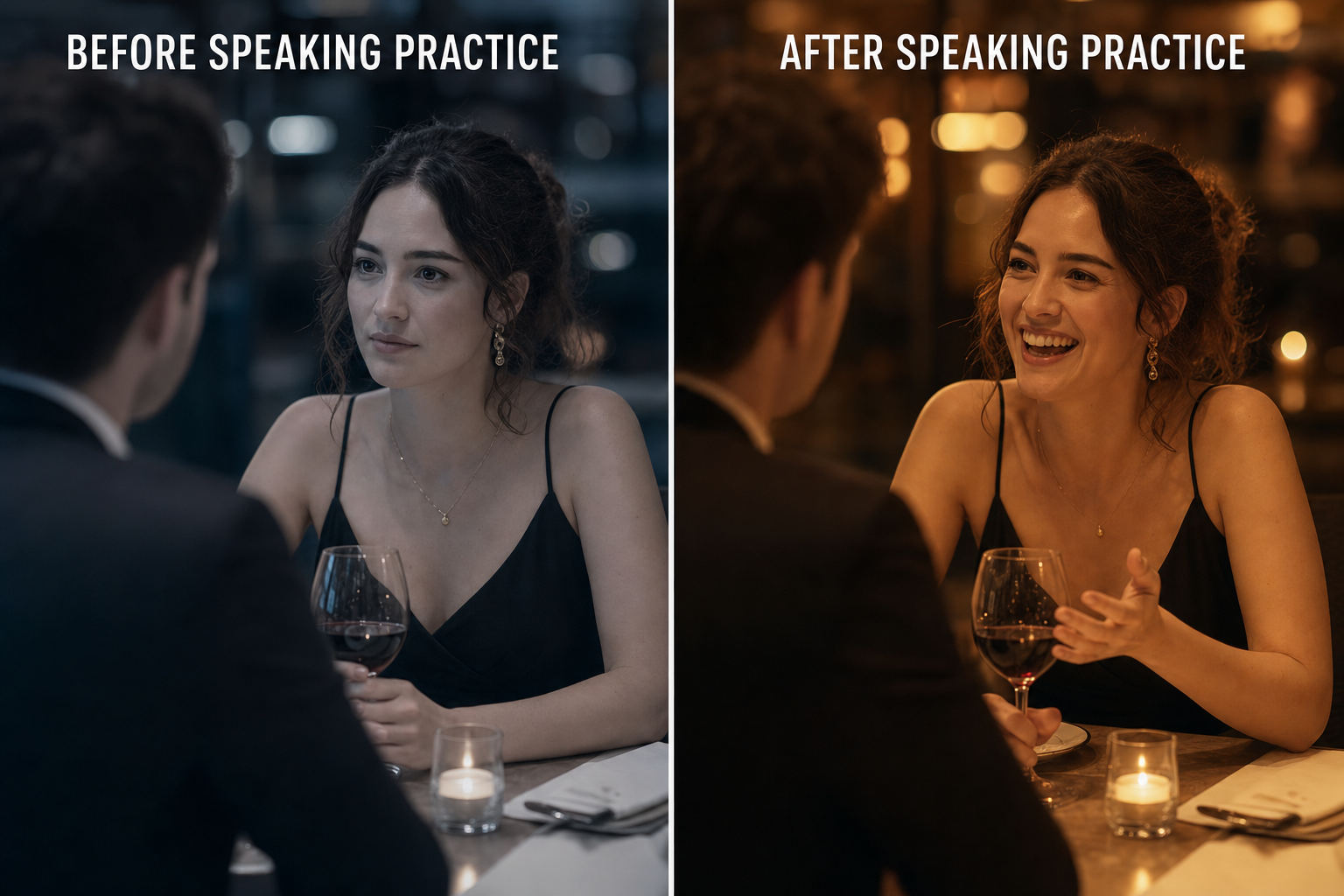
I've been on 23 dates in English over the past two years in London. On every single one, I was someone else.
Not a different person exactly. More like a photocopy of myself. Recognizable, but flatter, duller, missing the detail that makes the original worth looking at. Somewhere between "nice to meet you" and the first sip of whatever I'd ordered, the real me would quietly leave the building, and her polite, careful understudy would take the chair.
Take Tom. We matched on an app, texted for a week. Funny, easy, the kind of banter where you're already smiling before you open the message. He told a story about his cat learning to open the fridge, and I sent back something sharp about feline criminal behavior that made him respond with five crying-laughing emojis. In text, I was myself. Witty. Quick. A little weird.
Then we met at a wine bar in Shoreditch, and the cat came up again. He told the story live, leaning in, eyes bright, waiting for me to match his energy. And what came out of my mouth was: "Cats are interesting."
Cats. Are. Interesting.
A sentence that could have been generated by a malfunctioning chatbot circa 2014. Tom smiled politely and changed the subject. The spark between us didn't die. It had never shown up.
My dating profile says I'm spontaneous and witty. My dates say I'm polite and forgettable.
The person everyone thinks they know
Here's what makes it maddening: I'm not shy. I work in fintech in Canary Wharf. I've given presentations to rooms of 60 people in English without breaking a sweat. My manager called me "one of the most articulate people on the team." My English, by any professional metric, is excellent.
But there is a gap between the version of me that can deliver a quarterly results deck and the version who shows up to dinner with a man she might actually like. The professional version is competent. The dating version sounds like she's reading from an airport phrasebook.
The cruelest twist is the texting. On my phone, with time to compose and delete and try again, I am myself. I deploy sarcasm with surgical precision. Then men meet me across a table and get the customer service agent.
The science I wasn't expecting to find
I write features for Tessera, which means I talk to researchers about the gap between who we think we are and who we become in particular situations. When my editor suggested I look into bilingualism and personality, I assumed it would be a light piece. I didn't expect it to be about me.
My first call was with Jean-Marc Dewaele, a professor of applied linguistics at Birkbeck, University of London. His research with Aneta Pavlenko, a study of over 1,000 multilinguals, landed on something that stopped me cold (Dewaele & Pavlenko, 2002). The majority of participants reported feeling like a different person when they switched languages. Not just using different words but experiencing a genuine shift in personality, emotional range, and self-expression.
They reported feeling flatter, more cautious, less funny. A description that matched my dating life so precisely it felt like he'd been reading my diary.
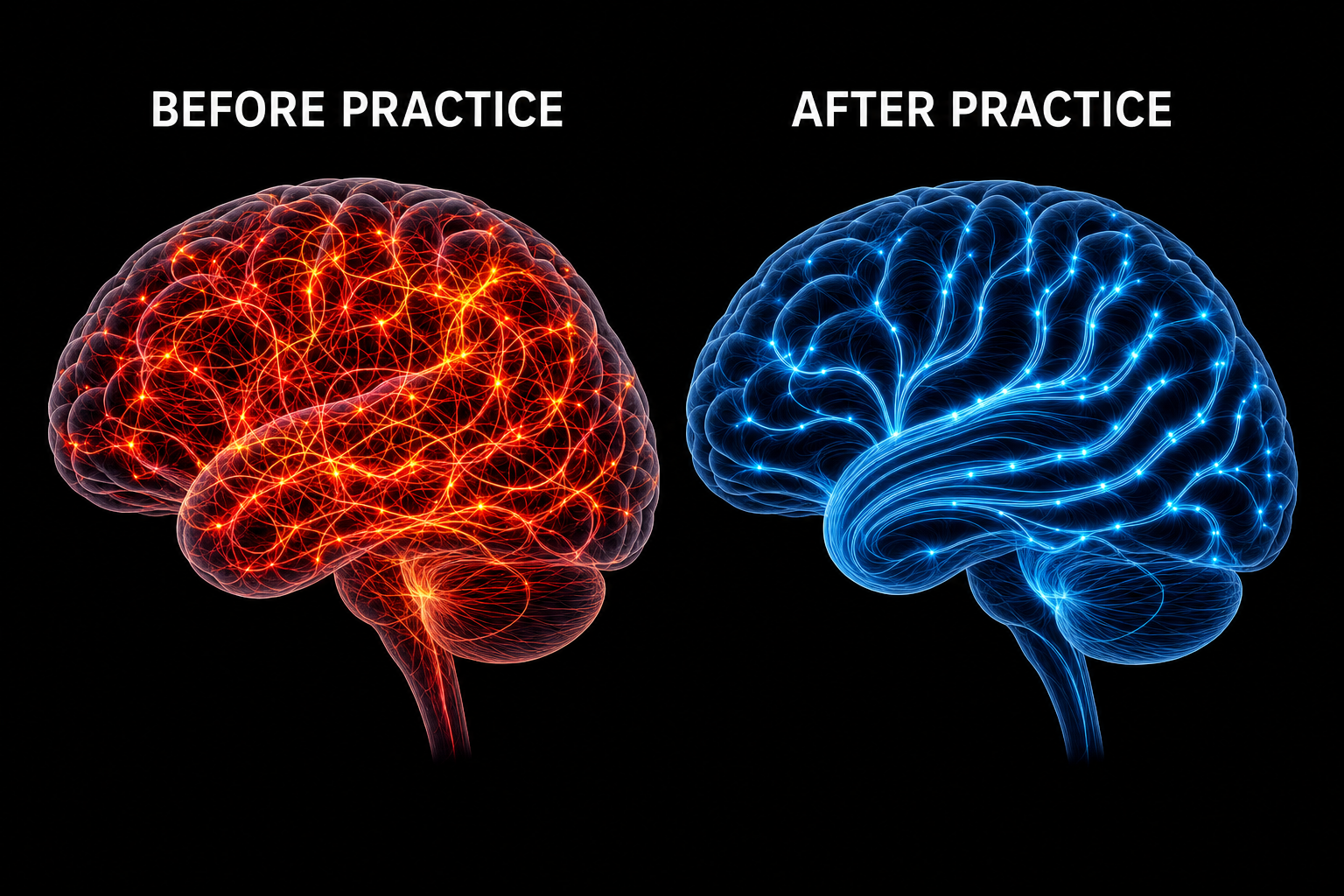
Then Dewaele explained why. Pavlenko's work established that roughly 80 percent of our emotional vocabulary is neurologically wired before the age of 12 (Pavlenko, 2005). Those early words aren't just labels. They're tangled up with memories, bodily sensations, the smell of your grandmother's kitchen, the first time someone said they loved you. Words learned later, in a second language, are stored differently. Semantically equivalent, but they don't carry the same weight.
I thought about how many times I'd tried to tell someone they were attractive, or that I was nervous in a good way, and the English words felt hollow. Not wrong. Just empty. Like picking up a beautiful cup and finding it had no bottom.
The apartment with the empty bedroom
Dewaele reframed the problem entirely. He said this wasn't a language problem. It was an identity problem.
Each language you speak is a version of yourself, shaped by where you learned it. Your first-language self was built through friendship, family conflict, teenage heartbreak, late-night conversations. Your second-language self was built in classrooms, offices, transactional encounters with landlords and shopkeepers. The contexts were professional, functional, formal. The self that emerged is narrow too.
My Spanish self lives in an apartment I've been furnishing for 25 years. Every room is full. Weird art on the walls, a kitchen that smells like something's always cooking. My English self lives in an apartment from a catalog. It looks fine. But the bedroom is empty. Nobody has ever cried there or laughed until they couldn't breathe.
No wonder my dates were flat. I was inviting people into an apartment with no furniture in the rooms that matter.
Merrill Swain's output hypothesis made painful sense. Producing language, not just understanding it, is what drives development toward fluency (Swain, 1985). I'd spent eight years in London speaking English at work, in shops, at the doctor. But I had never practiced being charming in English. Never practiced being vulnerable, or playful, or flirtatious. I had never furnished that bedroom.
"Have you tried Loku?"
My friend Carla said it casually over wine at her place in Hackney. She's Brazilian, works in UX, and shares 90 percent of my frustrations with being someone else on dates.
"My therapist told me to practice the conversations I'm afraid of," she said. "But you can't call up a stranger and say 'pretend we're on a first date.' So I started using Loku."
I was skeptical. I'd tried the big apps. Streaks and cartoon characters celebrating when you correctly translated "the cat is on the table." They had nothing to do with my problem. I didn't need to learn the word for "restaurant." I needed to learn how to be funny at one.
But Carla showed me. Loku wasn't vocabulary drills. It was real-time speaking practice under emotional pressure. AI tutors who respond naturally, push back, and make you think on your feet. Over 700 scenarios from job interviews to first dates to "define the relationship" conversations. The scenarios I'd been failing at in real life, available without consequences.
"No judgment," Carla said. "You can try the same sentence four different ways. When's the last time you could do that on an actual date?"
On a real date, every sentence is a one-take performance. You say the flat, safe thing because the cost of trying something bolder is social humiliation. What if you could fail privately until the risk of trying publicly felt manageable?
The cheese cave incident
My first session was with Nova, the playful tutor. First-date scenario. The prompt: share something memorable about yourself.
In Spanish, I have a story that kills. The time I accidentally locked myself in a cheese cave in the Basque Country during a family holiday when I was twelve. In Spanish, it's a three-minute bit with a punchline about how I still can't eat Idiazabal without mild PTSD.
In English, I heard myself say: "Once I was in a cheese cave and I couldn't get out. It was very interesting."
Very. Interesting. The obituary of every good story I'd ever told.
Nova didn't let it go. Instead of marking my grammar correct, Nova responded the way a human would: "A cheese cave? That sounds like either the best or worst day of your life. What happened?"
So I tried again. I slowed down and reached for the details. The smell. The darkness. My mother's voice getting fainter on the other side of the door. The moment I realized the cheeses were worth more than my family's car. I even tried a joke: "I think I aged faster than the cheese in there." It wasn't smooth, but it was mine.
Eight years in London. English every single day. And I had never once practiced humor, vulnerability, or playfulness in this language. I'd practiced presentations. Email etiquette. Politely disagreeing in meetings. But the parts of language that make you a person and not a professional? Zero.
The week my English started sounding like me
Week two. I'd been doing 15 to 20 minutes a day, usually after dinner.
The session that changed things: answering "What do you do for fun?" The most common first-date question and one I'd always answered with something generic. "I like cooking." "I enjoy traveling." The conversational equivalent of a stock photo.
Nova pushed back: "Come on, that's your LinkedIn bio. What do you actually do?"
I went off-script. I started talking about competitive baking shows. Not watching them, but the way I watch them, which involves shouting technical advice at the television and arguing with my flatmate about structural integrity in pastry. How I once paused an episode to look up the physics of choux pastry and spent two hours in a rabbit hole about steam expansion rates.
It wasn't perfect English. My grammar wobbled. I used "thing" when a better word existed but didn't arrive in time. But it was MY English. For the first time in years, I sounded like myself in this language. Not translated. Not performing. Actually me.
"In person you're even better"
His name was James. We met at a pub in Angel. The usual easy texting beforehand that I'd learned to distrust because it never survived contact with reality.
This time it did. When he told a story about getting lost in Rome, I said, "Please tell me you asked for directions in Italian and accidentally ordered a pizza." He laughed. Actually laughed. The joke had happened in real time. Not pre-composed, not translated, just there.
Walking to the Tube, he said: "Your texts were great, but in person you're even better."
I almost cried. For two years, every date had confirmed the opposite. To hear someone say the live version was better felt like proof that what I'd been working on was actually working.
My mother, on our weekly video call: "You sound like yourself again. I was worried your English was eating you."
She was right. I had put down the constant work of translating myself in real time, of choosing the safe word over the right word because the safe word was faster.
Why everything else I tried didn't work
Traditional vocabulary apps taught me thousands of words. What I couldn't do was use any of them while a man I found attractive was looking at me and waiting for me to be interesting. Vocabulary without context is like owning a piano you've never played.
Language classes improved my grammar and pronunciation. But a classroom of fifteen students can't simulate emotionally loaded, spontaneous, one-on-one conversation. Horwitz's work on foreign language anxiety identified social evaluation as a core driver of L2 anxiety (Horwitz et al., 1986). Practicing flirting in front of a class would have made things worse.
Language exchange partners came closest, but the dynamic was transactional. The conversations never pushed into vulnerable, risky territory.
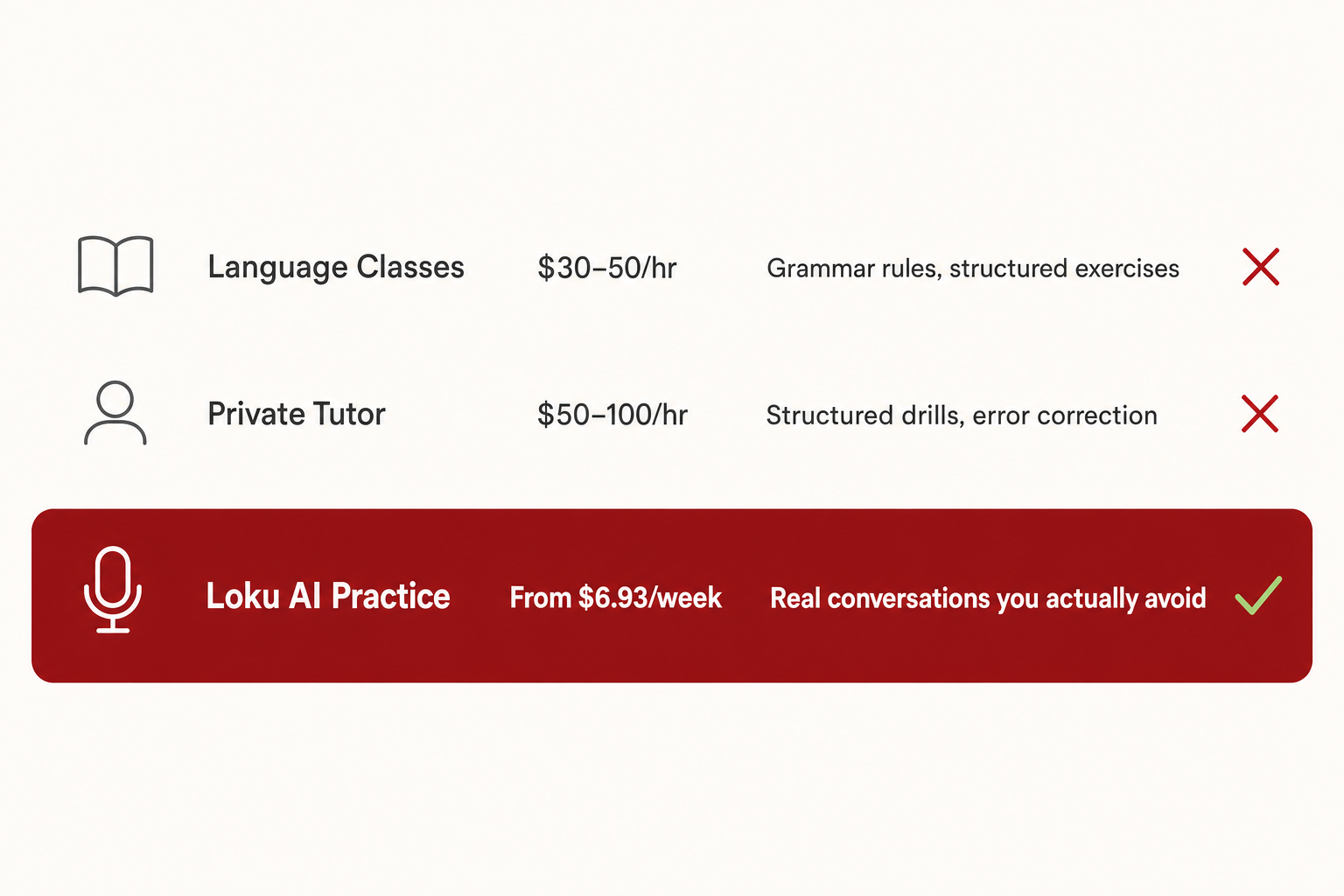
Every app taught me words. None of them taught me to be myself in English. The problem was never my English. The problem was that nobody had given me a space to build the emotional version of my English self.
What I'd tell the version of me sitting in that wine bar
If I could go back to that date with Tom, I wouldn't give myself a phrasebook. I'd tell myself the problem wasn't what she knew. It was what she'd never practiced.
If that's where you are right now. If you're funny in texts and flat in person, if you nail presentations but can't get through a first date without feeling like a tourist in your own personality. It's not permanent. It's a muscle you haven't trained, and it responds to training faster than you'd expect.
Loku offers a two-minute quiz that builds a personalized speaking plan based on your goals. Fifteen minutes a day. That's what it took for me.
Stop translating yourself. Start speaking as yourself.
Date number 24
Last Thursday. A bar in Dalston. I didn't rehearse anything on the walk over. Didn't pre-translate jokes from Spanish.
I just showed up. As me.
He told a story about accidentally adopting a dog in Portugal, and I told him about the cheese cave, and it was funny. Really funny, the way it's always been in Spanish. He nearly choked on his drink, and I felt something I hadn't felt on a date in English in two years.
I felt like myself.
Not the translated version. Not the polite-and-forgettable version who says "cats are interesting." The real one. The one who's been here all along, waiting for a language to come home to.

Results may vary. Tessera does not provide relationship or professional advice.
Comments (5)
Two years of apps. Same wall. This is the first thing that actually described what I was feeling.
The cheese cave story killed me. I have my own version — trying to explain a Brazilian joke in English and watching it die in real time. Every. Single. Date.
I showed this to my therapist. She said the reduced personality research is legitimate and she wishes more of her bilingual clients understood this distinction.
"Cats are interesting." I'm crying. That's literally me. I once told a date his eyes were "a good color" when what I meant was something much more specific and warm.
The apartment metaphor is going to stay with me. Furnished living room, empty bedroom. That's exactly what my English feels like.