I spent 10 years learning English grammar. A linguist told me to stop.
I could pass any English test. I could write flawless emails. But every time I opened my mouth in a meeting, my mind went blank. A conversation with a Stanford researcher changed everything.


I have a C2 certificate in English. I scored 8.5 on the IELTS. I can diagram a sentence, explain the difference between the past perfect and the past perfect continuous, and write a 3,000-word report without a single grammatical error.
Last Tuesday, my manager asked me a simple question in a team standup — "Marco, what's your take on the new timeline?" — and what came out of my mouth was: "I think... the timeline is... it could be... yes, it's fine."
Eleven words. Zero information. The kind of answer that makes everyone in the room quietly move on.
I am 34 years old. I have lived in Toronto for six years. I work as a data engineer at a company where every conversation happens in English. And I still freeze when someone puts me on the spot.
Not because I don't know the words. Because my mouth refuses to release them in real time.
The paradox nobody talks about
Here is what I could never explain to my Canadian colleagues, my therapist, or frankly myself: my English is excellent. On paper. In writing. Given 30 seconds to compose a Slack message, I am articulate, precise, occasionally even funny. My performance reviews describe me as "a clear communicator with strong analytical writing."
But speaking is a different system entirely. Speaking is live. Speaking doesn't give you 30 seconds. Speaking requires you to think, construct, and deliver simultaneously, while someone is looking at you, while the silence is building, while your brain is running two parallel tracks — one producing English, the other monitoring whether the English sounds stupid.
Peter MacIntyre, a psychologist at Cape Breton University, calls this "the willingness to communicate" problem (MacIntyre et al., 1998). His research shows that language competence and communication confidence are two separate systems. You can max out one and completely stall on the other. Knowing the grammar doesn't mean you'll use it. Knowing the vocabulary doesn't mean you'll access it under pressure. The knowledge is there. The performance pathway is blocked.
I had spent a decade building an English that lived in my head. Nobody had told me I needed to build one that lived in my mouth.
4,000 hours of input. Zero hours of output.
I did the math once, sitting in a coffee shop in Kensington Market, trying to figure out where I'd gone wrong.
Between high school in Sao Paulo, an English-language engineering degree, three years of Netflix with subtitles, two grammar textbooks I'd completed cover to cover, and daily news podcasts: roughly 4,000 hours of English input. Reading, listening, absorbing.
Hours of spontaneous, unscripted, real-time speaking practice: effectively zero.
Not conversations — I'd had thousands of those. But conversations where I was ordering food, giving updates in standups, confirming meeting times. Transactional English. The kind where a ten-word sentence does the job and nobody cares about nuance.
I had never practiced the kind of speaking that requires you to think out loud. To build an argument in real time. To tell a story with timing and emphasis. To disagree with someone without rehearsing the sentence first.
Merrill Swain figured this out in 1985. Her output hypothesis established that comprehension and production are fundamentally different cognitive processes (Swain, 1985). You can understand everything and still not be able to produce fluently. Because production requires a different neural pathway — one that only develops through production.
I had been trying to learn to swim by watching swimming tutorials. For ten years.

The meeting that broke something
March. Quarterly planning. My team lead asked each of us to pitch one idea for the next sprint. I had a good one. I'd been thinking about it for a week. I'd even written notes.
When my turn came, I opened my mouth, and what happened next is something every non-native speaker will recognize: the idea was there, complete and coherent, sitting in my brain in Portuguese. And between my brain and my mouth, it hit a wall.
Not a vocabulary wall. I knew every word I needed. A confidence wall. A wall made of every time I'd mispronounced something and seen someone's eyebrow twitch. Every time I'd used the wrong preposition and watched someone's focus shift from what I was saying to how I was saying it. Every time I'd started a sentence and abandoned it halfway because a better English speaker jumped in to finish my thought.
Elaine Horwitz's research on foreign language anxiety identified three components: communication apprehension, fear of negative evaluation, and test anxiety (Horwitz et al., 1986). In that meeting, I had all three running simultaneously. I was afraid to speak, afraid of being judged, and afraid of failing a test nobody had set but me.
I delivered my idea in four flat sentences. My colleague Dave, who'd had a similar but weaker idea, pitched his with enthusiasm and hand gestures and a joke about "scope creep being the real pandemic." Dave's idea got greenlit. Mine didn't. Not because his was better, but because his sounded better.
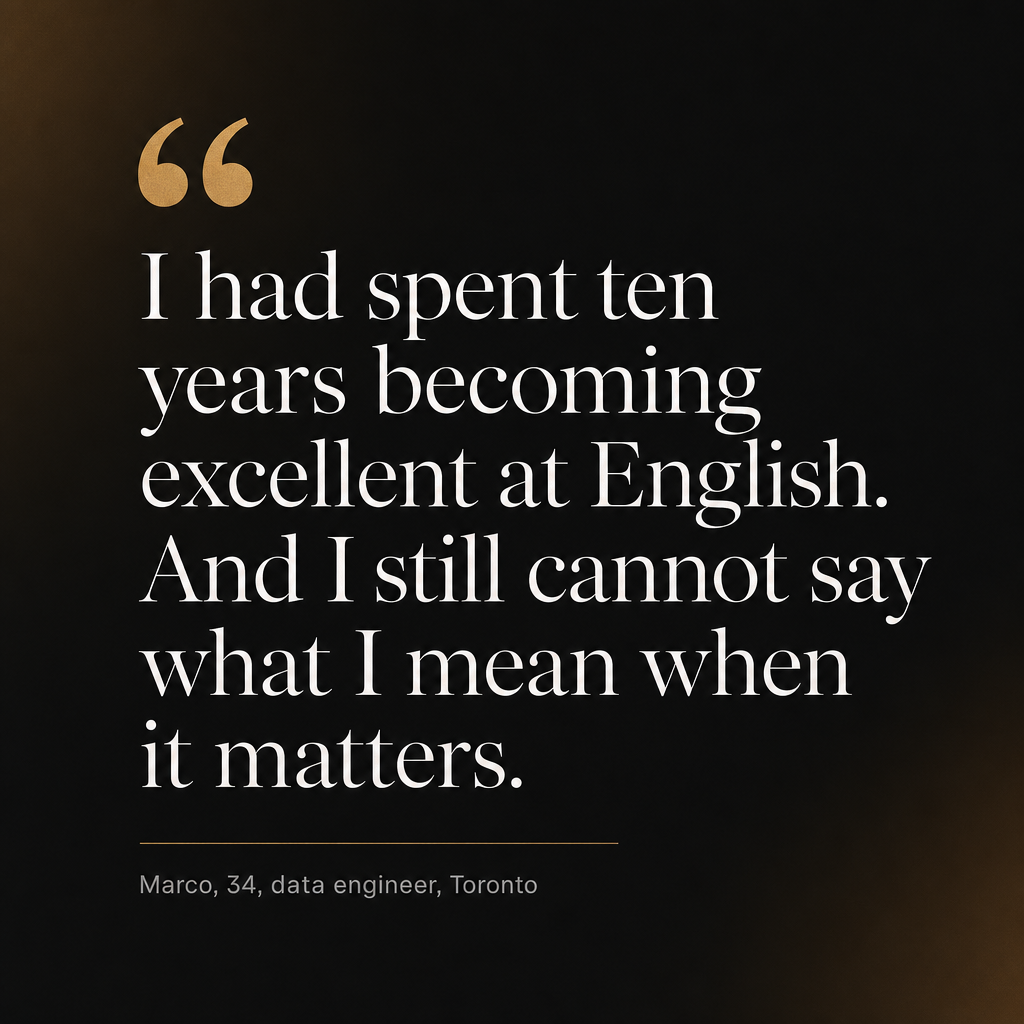
That evening I sat in my apartment and thought: I have spent ten years becoming excellent at English. And I still cannot say what I mean when it matters.
"You don't have a language problem."
Dr. Tracey Derwing at the University of Alberta told me something I wasn't ready to hear (Derwing & Munro, 2005). I'd reached out for a piece I was researching for Tessera about accent bias in workplaces, and somewhere in the conversation I mentioned my own situation.
"Your English is clearly fluent," she said. "You don't have a language problem. You have a production confidence problem. Your comprehension system is years ahead of your production system because you've only ever trained one of them."
She explained that most language learners — especially adults who learned English through formal education — develop what researchers call a "comprehension-production asymmetry." Their passive knowledge is vast. Their active output is narrow. Not because they lack ability, but because they lack practice. Specifically, they lack low-stakes production practice — opportunities to speak freely without professional or social consequences.
"Think of it this way," she said. "A pianist who only ever practices scales will freeze at a recital. Not because they can't play. Because they've never performed. Performance is a skill. It requires separate training."
I'd been practicing scales for ten years. I had never given a single recital.
The gym for speaking
My sister sent me a link. "Try this. My friend in Lisbon swears by it."
I almost didn't click. I'd downloaded language apps before. Five, maybe six, over the years. They were all the same: vocabulary flashcards dressed up with gamification. Streaks. Badges. A cartoon owl congratulating me for knowing the word for "umbrella." None of them had ever made me better at speaking because none of them involved actual speaking.
Loku was different. No flashcards. No grammar drills. Just real-time conversation with AI tutors who responded like humans. Not like chatbots repeating "Great job!" but like people who challenged you, interrupted you, asked follow-up questions, and didn't let you hide behind safe, pre-constructed answers.
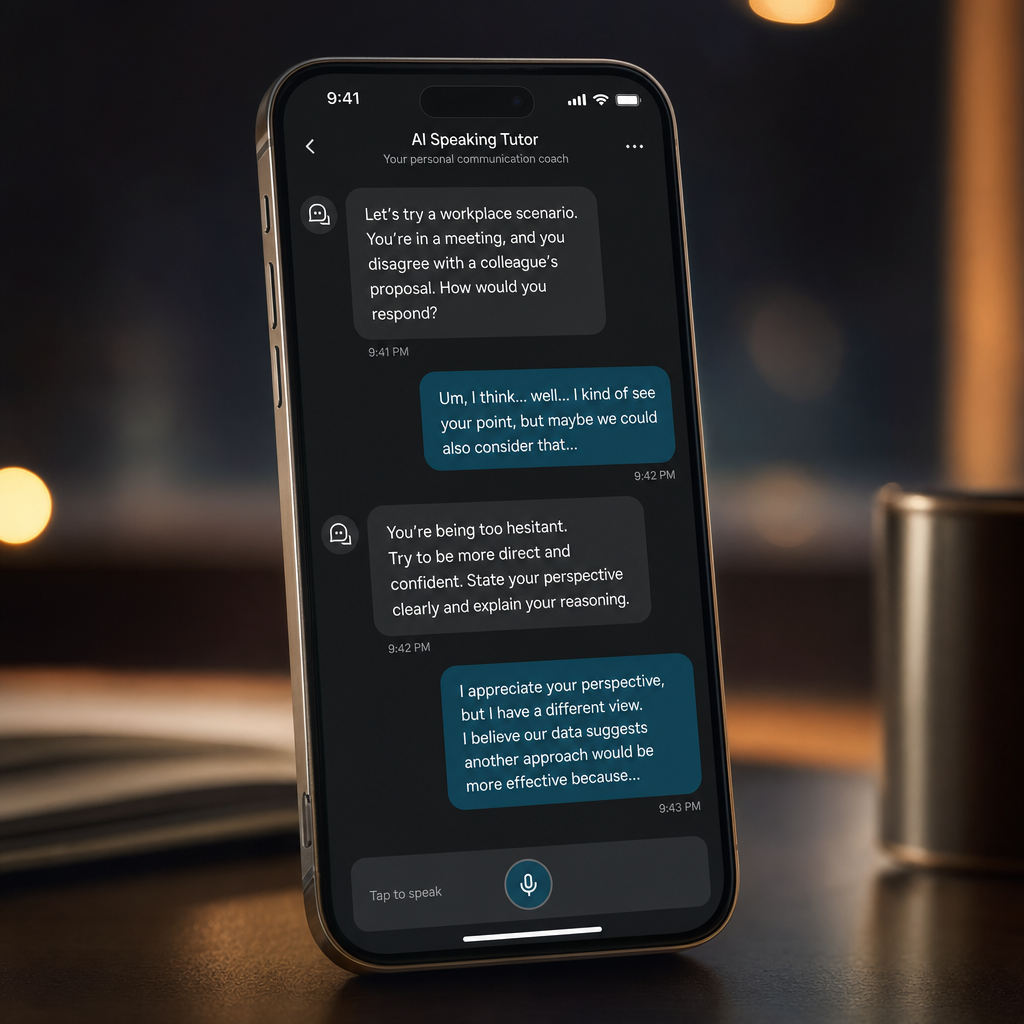
The first session I tried was a workplace scenario: "Your colleague just presented an idea you disagree with. Respond in the meeting."
In real life, I would have said nothing. Or I would have typed my disagreement in Slack 20 minutes later, carefully edited, after the decision had already been made.
With Loku, I had to respond immediately. Out loud. In real time.
My first attempt: "I think maybe we could consider that there might be another approach that could potentially..." Twelve words of hedging that said absolutely nothing.
The tutor, Sage, cut in: "I heard a lot of 'maybe' and 'could' and 'potentially.' What do you actually think?"
I took a breath. "I think the timeline is too aggressive and we'll burn out the team by week three."
Clear. Direct. Twelve words, but these ones meant something. And the world didn't end. Sage didn't flinch. Nobody judged me. The stakes were zero, and that made all the difference.
What 15 minutes a day actually does
The research supports what I felt happening. Paul Nation, a linguist at Victoria University of Wellington, demonstrated that fluency develops through what he calls "meaning-focused output" — speaking where the goal is communication, not accuracy (Nation, 2007). When learners focus on getting their message across rather than constructing perfect sentences, their production speed increases, their hesitation decreases, and their confidence compounds.
Loku, without me realizing it, was applying exactly this principle. The scenarios weren't grammar exercises. They were situations. Arguing with a landlord. Explaining a technical concept to a non-technical person. Comforting a friend who just got bad news. Telling a story at a party.
Every scenario forced me to produce language under mild time pressure, with an interlocutor who reacted naturally. No scoring. No red underlines. No "the correct answer was..." Just a conversation that pushed me slightly beyond my comfort zone, every single time.
After one week — maybe six sessions of 15 minutes — I noticed something strange. In a team chat, instead of typing my response, I unmuted and said it. It wasn't eloquent. But I said it. Live. Without rehearsing.
After two weeks, I stopped translating from Portuguese in my head before speaking. The English started coming from somewhere else. Not from my grammar knowledge, but from a newer, faster system — the one I was building through daily output practice.
The standup that changed everything
Week three. Monday morning standup. My turn.
"I refactored the data pipeline over the weekend because the current one has a silent failure mode that's been corrupting about 2% of records. It took longer than I expected because the upstream schema has three undocumented fields, but it's deployed now and I'm monitoring it."
My tech lead paused. "That's... really useful context, Marco. Can you write that up for the incident log?"
It wasn't poetry. But it was the first time in six years that I had spoken in a meeting and felt like I'd actually communicated. Not just delivered words, but transferred an idea from my brain to someone else's, live, in English, without the usual fog of anxiety between thought and speech.
That afternoon, Dave — the colleague whose mediocre idea had beaten mine three months earlier — asked me about the pipeline fix. I explained it. With detail. With a joke about the undocumented fields being "the database's way of keeping secrets." He laughed. I couldn't remember the last time I'd made someone laugh in English at work.
Why grammar study made it worse
Here's what nobody told me and what I wish someone had: studying grammar was actively making my speaking worse.
Not because grammar is bad. But because grammar study trains you to monitor every sentence for errors before you release it. It turns speaking into proofreading in real time. Every sentence runs through an internal quality check: Is the tense right? Is it "in" or "on"? Is "which" or "that" correct here? Should I use the subjunctive?
By the time the sentence passes quality control, the conversation has moved on. The window is closed. The moment where your contribution would have been relevant is gone.
Krashen called this the "Monitor Model" (Krashen, 1982). Learners who over-rely on their conscious knowledge of grammar rules become so focused on accuracy that their fluency collapses. They know more but say less. Their English is theoretically perfect and practically useless.
I had the most monitored English in every room I walked into. And the most silent.
What Loku did, mechanically, was override the monitor. When a tutor responds to you in real time and expects an answer, you don't have time to proofread. You just speak. And you discover — painfully at first, then with growing relief — that imperfect English that lands is infinitely more effective than perfect English that never leaves your mouth.
The comparison I didn't want to make
I made a list. Everything I'd tried over ten years versus three weeks with daily speaking practice.
Grammar textbooks gave me knowledge I couldn't access under pressure. Language classes gave me accuracy in artificial environments that collapsed in real ones. Vocabulary apps gave me words I recognized in reading but couldn't retrieve in conversation. Conversation exchanges gave me the anxiety of performing for a stranger with no structure or feedback.
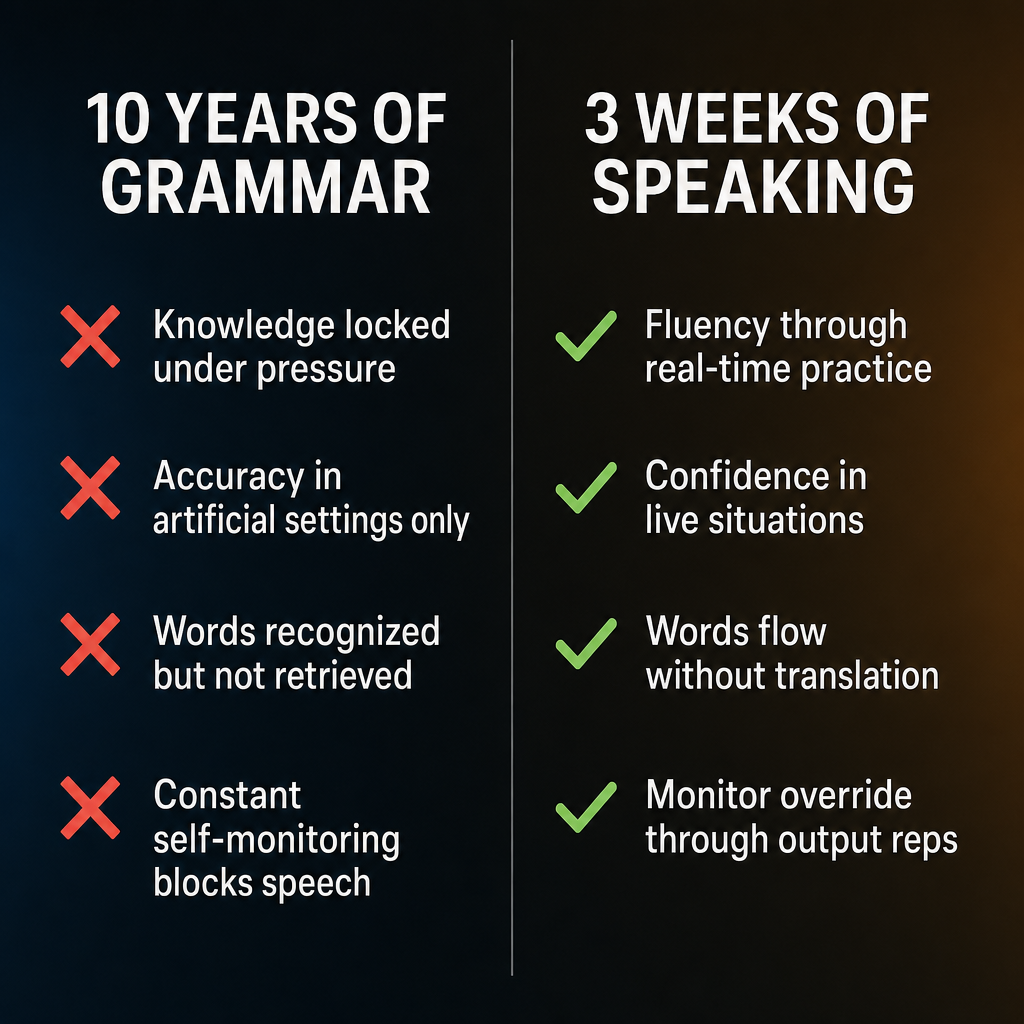
Fifteen minutes a day of structured, scenario-based speaking practice gave me the thing none of them could: the experience of hearing myself speak English fluently. Not perfectly. Fluently. There is a difference, and it is the difference between knowing a language and living in one.
What I'd tell the version of me sitting in that standup
If I could go back to every meeting where I sat silent while someone less knowledgeable spoke louder, I wouldn't give myself a grammar book. I'd give myself permission to be imperfect out loud.
If you're reading this and recognizing yourself — if your English is excellent on paper and invisible in person, if you can write emails that impress people and give answers that disappoint them, if you've spent years studying a language you still can't speak under pressure — I want you to know: you don't need more knowledge. You need more reps.
Loku offers a two-minute quiz that builds a personalized speaking plan based on your goals. It takes 15 minutes a day. That's what it took for me.
Stop studying English. Start speaking it.
The email I almost didn't send
Last week, my skip-level manager posted a call for volunteers to present at the company all-hands. 200 people. A ten-minute slot on data quality practices.
The old Marco would have closed the email and gone back to his code editor. The old Marco would have told himself that his English wasn't ready, that he'd embarrass himself, that someone more fluent should do it.
I volunteered. Not because my English is now perfect. It isn't. I still reach for words sometimes. I still hear a slight accent that I used to be ashamed of and have slowly made peace with. I still occasionally say "in" when I mean "on" and catch it a beat too late.
But I'm done waiting for my English to be ready. My English was ready years ago. I just never let it out of the building.
The presentation is next Tuesday. I've been practicing with Loku's public speaking scenario every evening. Not memorizing a script — practicing the skill of thinking out loud in English, of trusting that the next word will come, of being comfortable with the half-second pause that used to terrify me and now just means I'm choosing the right word instead of the safe one.
Ten years of grammar. Three weeks of speaking. One of them changed my life.

Results may vary. Tessera does not provide career or professional advice.
Comments (0)